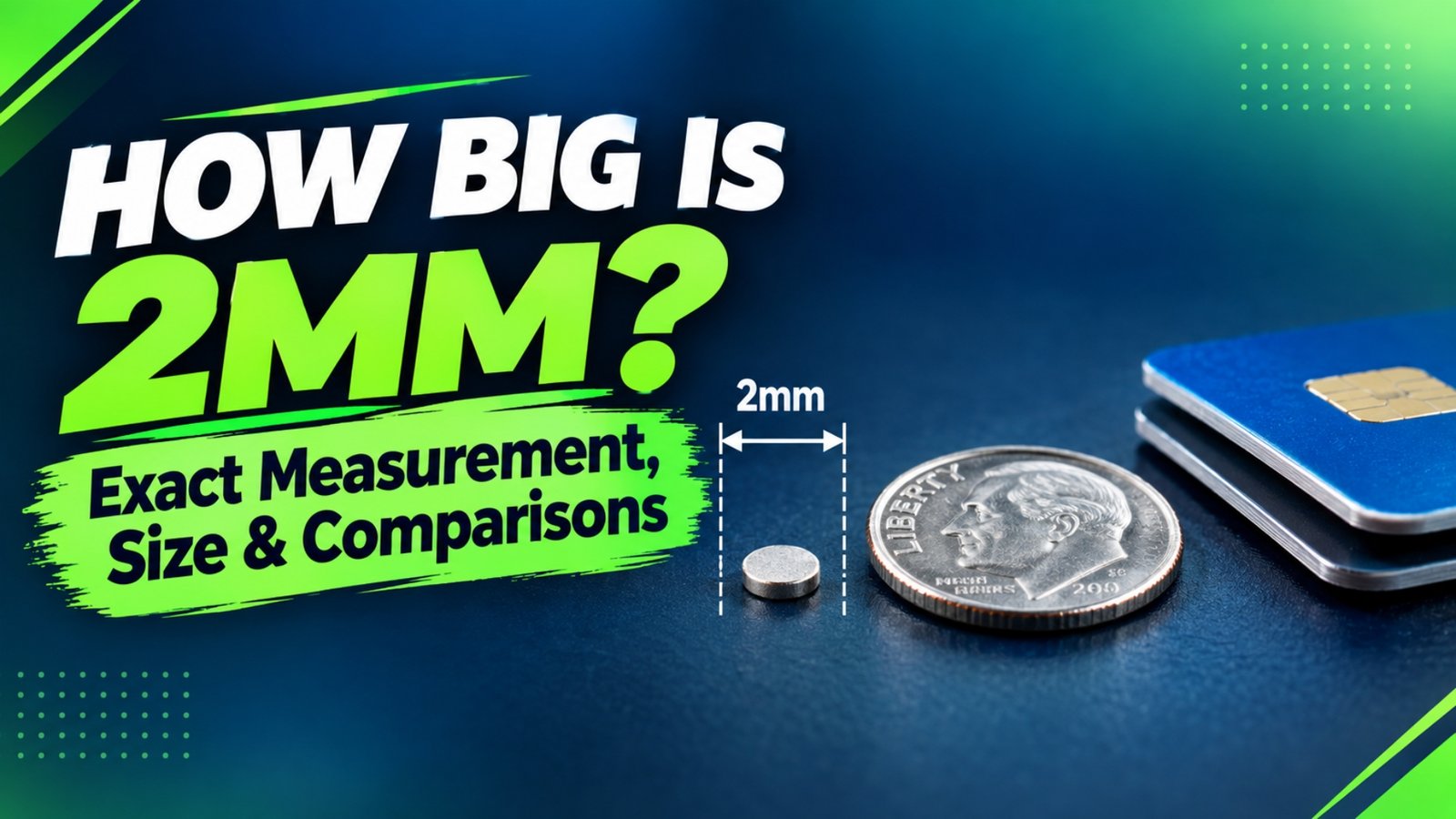
How Big Is 2mm? Exact Measurement, Size & Comparisons
Have you ever wondered how such a tiny measurement like 2mm can make a significant difference in your daily life? In fact, 2 millimeters is just 0.0787 inches, or less than one-tenth of an inch, yet this seemingly small dimension is crucial in fields ranging from engineering to precision crafts.
Americans think in inches, often overlooking the significance of smaller units like 2mm. Understanding how big is 2mm truly can enhance your perspective on everything from product design to natural phenomena.
This article will break down the exact measurement of 2mm, offer relatable comparisons, and explore its relevance in various contexts.
How Big Is 2mm? Exact Measurement in Inches
To grasp How big is 2 mm visually?, consider that one inch equals 25.4 millimeters. This means that 2 mm translates to roughly 8/100ths of an inch almost negligible when visualized on a standard ruler. This minuscule measurement showcases just how finely nuanced the metric system can be, which is particularly useful in fields like engineering and precision crafting.
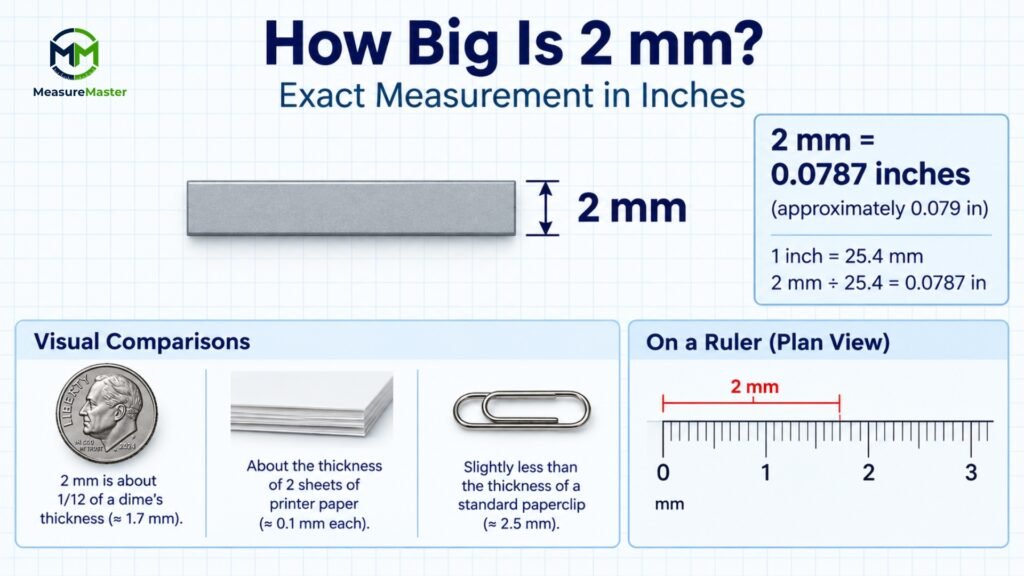
In everyday terms, 2 mm is about the thickness of a credit card or approximately the width of a fine pencil line. It’s easy to overlook such petite dimensions, yet they play a vital role in manufacturing and design.
Understanding these measurements can enhance your appreciation for the precision involved in various industries.
2mm Conversion Chart
| Unit | Equivalent of 2 mm |
| Inches | 0.0787 in |
| Centimeters | 0.2 cm |
| Meters | 0.002 m |
| Micrometers | 2,000 µm |
| Feet | 0.00656 ft |
| Yards | 0.00219 yd |
How Thick Is 2mm?
When considering the thickness of 2mm, it’s essential to appreciate its subtlety and application in various contexts. In imperial measurement, 2mm equals approximately 0.0787 inches, or just over 5/64 of an inch.
This seemingly minuscule dimension often plays a crucial role in industries ranging from manufacturing to graphic design. Whether it’s the thickness of a small electronic component or the precision of a paper type, understanding 2mm can make a significant difference in quality and functionality.
In everyday terms, 2mm is roughly the thickness of a credit card or a standard business card. This comparison helps visualize how this measurement could blend seamlessly into our daily lives.
How Much Does 2 mm Look Like?
When we think of 2 mm, it might seem like an insignificant measurement, but it’s fascinating to discover what this small length truly represents in everyday life. Visually, 2 mm is a very small length, equal to about 0.08 inches.
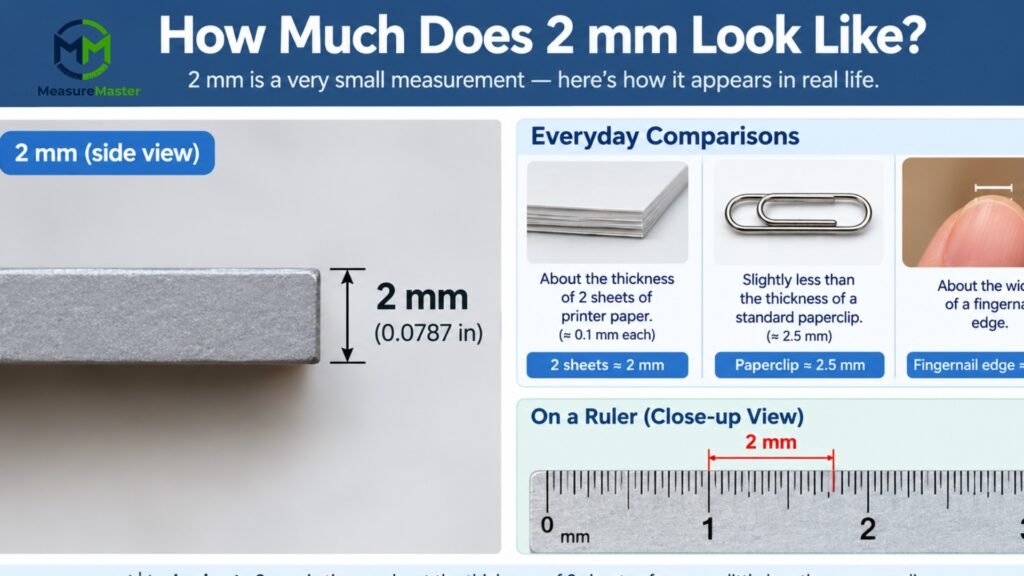
To picture it in everyday terms, it’s roughly the thickness of two standard credit cards stacked together. It’s also slightly thicker than a U.S. dime, which is about 1.35 mm thick, making these familiar objects useful references for understanding just how small 2 mm really is.
From the thickness of eyeglass lenses to the seam allowances in clothing, the 9 most common things that are 2mm are minute details that influence both functionality and aesthetics in our daily environment.
2mm Comparison to Everyday Objects
Here are most common 2mm example from everyday objects that are 2mm wide. Each measurement reminds us that precision can have a larger impact on our lives than we often recognize.
Credit Card
The thickness of a typical credit card, which measures about 0.76mm. Stack a couple of those cards together, and you’ll reach that 2mm mark, just enough to highlight how easily we overlook measurements in our daily transactions.
Pens
Take a closer look at pens, many fine-tipped rollerball pens feature a nib that’s around 0.5mm to 1mm thick. While this subtle difference might seem negligible, it can significantly impact the smoothness of your writing.
Staple
Another common object is a staple, which typically has a crown of approximately 2mm, making it a perfect example of how small dimensions can hold structural integrity in everyday tasks.
A Pencil Lead
Mechanical pencil lead, particularly in the common 2mm width, offers a unique blend of precision and versatility that sets it apart from traditional wooden pencil leads. This wider diameter not only allows for a smoother application but also results in reduced breakage, which is a common frustration among artists and students alike.
When you use 2mm lead, the heftier stock creates sharper lines that are ideal for detailed sketching or writing, making it a preferred choice for those seeking clean, well-defined marks on their paper.
Moreover, the versatility of 2mm lead extends beyond just its width, it comes in various hardness grades, from soft to hard, which can dramatically affect the quality and texture of your work.
U.S. Nickel Coin
The U.S. nickel, measuring approximately 1.95 mm thick, presents an interesting case when we explore the significance of its dimensions. If we consider common objects in our daily lives, a typical paperclip measures around 1 mm in diameter, making a nickel slightly thicker than two stacked paperclips.
This 2 mm size comparison helps illustrate the coin’s dimensions in a way that’s relatable and tangible, grounding its thickness in everyday reality.
A Mustard Seed
The mustard seed, specifically the black mustard seed from Brassica nigra, measures just around 2mm in diameter. This tiny yet mighty seed serves as a powerful metaphor in various cultures, illustrating themes of faith, growth, and potential.
When you consider its diminutive 2mm size, it’s astonishing to think that this single seed can yield a plant that reaches heights of several feet. This perspective not only underscores the seed’s physical size but also invites us to ponder the immense possibilities that lie within small beginnings.
Ceramic Tile Spacer
When it comes to tile installation, achieving precision is paramount, and 2mm ceramic tile spacers play a crucial role in this process. These small but mighty tools ensure consistent grout gaps, which are not only aesthetically pleasing but also vital for the integrity of the tiled surface.
A uniform 2mm gap between tiles allows for expansion and contraction, preventing cracks and enhancing durability.
Opting for the right spacers, such as X-shaped or T-shaped ceramic tile spacers, can significantly influence the outcome of your project. X-shaped spacers are ideal for traditional square patterns, while T-shaped spacers are particularly effective for brick-pattern installations, where staggered tiles require a keen eye for alignment.
A Matchstick
The shaft of a standard matchstick, measuring a precise 2mm thick, is an excellent example of engineering finesse within a simple object. This craftsmanship ensures that when struck, the match ignites steadily, providing just the right burn time for safety and utility.
Inside a matchbox measuring 50.5mm × 37.5mm, dozens of these carefully constructed sticks fit snugly together, highlighting not only their functional design but also the compact efficiency we often overlook.
While the matchstick is universally recognized, its potential as a measurement reference is often ignored. The subtle elegance of its design a 2mm diameter shaft that balances durability with flammability serves to remind us that innovation often resides in the smallest of details.
Small Bead
Small beads, often measuring around 2mm, may seem insignificant at a glance, but their impact in jewelry design and crafting is profound. These diminutive gems can add intricate detail and depth to pieces, allowing artisans to create elaborate patterns and textures that larger beads simply cannot achieve.
The beauty of a small bead lies in its versatility it complements more prominent design elements while still making a statement. Incorporating small beads into your work encourages a closer examination of color, light, and gives you a useful sense of how big is 2mm in really.
You May Also Read: How Tall Is a Monster Can? Little-Known Size Facts
How to Measure 2mm Accurately
Measuring 2mm accurately requires both precision and using the right tools.
- Metric Ruler: locate the 2mm mark, which can be tricky if you are unfamiliar with millimeter increments. For added accuracy, consider digital calipers; they provide a clear readout and can be adjusted for even the slightest discrepancies, ensuring your 2mm measurement is spot-on.
- U.S. Nickel: If you find yourself without a ruler, everyday objects like a U.S. nickel can serve as improvisational tools. The coin measures approximately 2mm in thickness, allowing you to compare sizes visually or by stacking them for measurement.
- Digital Caliper: Whether you’re working on intricate crafts or precise engineering tasks, mastering how to measure 2mm accurately opens the door to fine-scale projects. When you need to measure something as small as 2 mm, a digital caliper makes the job much easier. With readings as precise as 0.01 mm, it’s useful for checking tiny dimensions where an ordinary ruler simply isn’t accurate enough.
Conclusion
2mm may seem like a tiny measurement, but it is easy to visualize when compared with familiar objects. It is about 0.08 inches thick, making it small enough to be difficult to judge accurately without a reference. A 2mm thickness is roughly comparable to the thickness of two stacked credit cards, giving you a simple way to picture the size.
Understanding how big is 2mm, can be useful when working with small parts, crafts, tools, jewelry, and other precision applications where even a few millimeters can make a noticeable difference.
FAQs
What Does 2 mm Look Like?
On a metric ruler, 2 mm is the second small line after the 0 mark. Each tiny line represents 1 mm, so counting two lines gives you 2 mm. It’s a very small distance just 0.2 cm or about 0.079 inches.
Is 2 mm Bigger Than 2 cm?
2 mm is smaller than 2 cm. Since 1 cm equals 10 mm, 2 cm is equal to 20 mm. So, 2 mm is one-tenth the size of 2 cm.
How Wide is 2mm?
2 mm is a very small width equal to 0.2 cm or about 0.079 inches. For a simple visual reference, it’s roughly the width of a small pencil lead or a tiny bead.
What Is 2mm Comparable To?
2mm is about 0.08 inches thick, roughly comparable to the thickness of a standard U.S. penny. It gives you a useful sense of how thin 2mm really is.